05-Aug-2026
Water makes up 70–80% of a cell’s mass, yet its role at the molecular level has remained largely invisible. Now, an international research team led by Professor Dong Wang (University of California, San Diego), and Professor Peijun Zhang (University of Oxford) has uncovered how water molecules actively shape gene transcription. Their findings, recently published in Molecular Cell, provide a near-atomic (sub-2 Å) resolution view of water’s critical role within RNA polymerase II (Pol II) – the enzyme responsible for synthesising messenger RNA.
The Zhang group at the University of Oxford developed a monodisperse streptavidin affinity grid to optimise particle orientation and enrich samples, as reported in Nature Communications in 2024. By combining this with a biotinylated nucleic acid scaffold, they improved RNA polymerase II orientation and reduced air–water interface effects, enabling a 1.96 Å pre-catalytic structure. Further optimisation led to a “substrate-gradient affinity grid” approach, introducing substrates before vitrification to delay reaction activation. This enabled capture of catalytic intermediates and clear visualisation of the water network, providing a structural basis for understanding transcription (Figure 1).
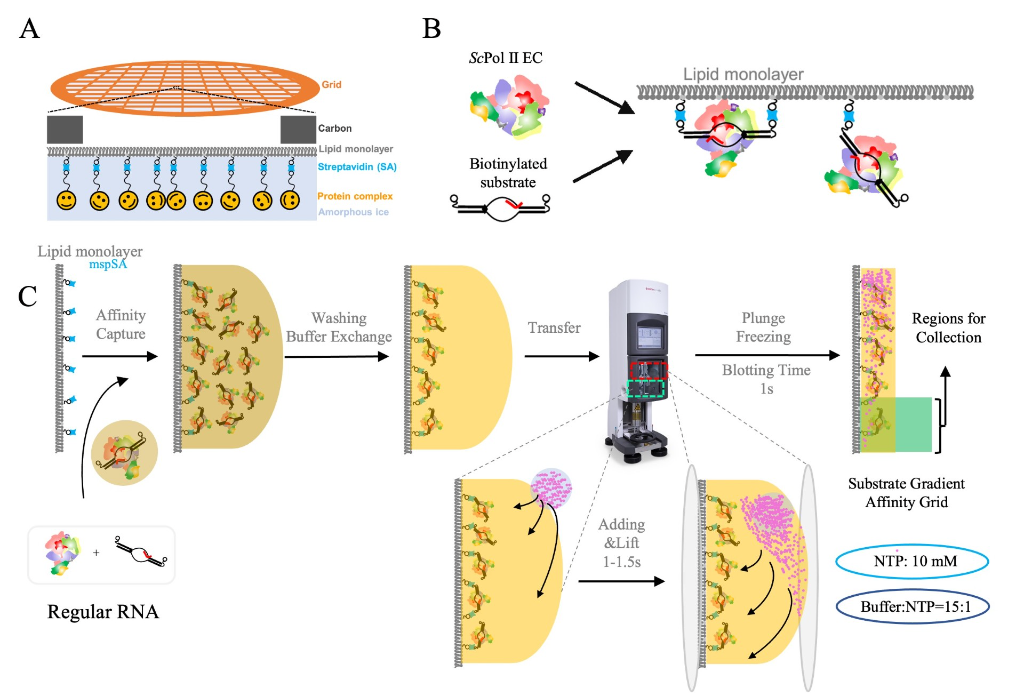
Figure 1. Schematic workflow of cryo-EM sample preparation using a monodisperse streptavidin affinity grid.
Using cutting-edge cryo-electron microscopy at near-atomic (sub-2 Å) resolution, the researchers captured Pol II in its active state and identified more than 1,300 water molecules forming an extensive and highly organised network. Previously undetectable due to resolution limits, these water molecules act as a “hidden layer” within the transcription machinery. The study shows that water molecules are not passive but actively participate in substrate recognition, catalytic reactions, and molecular interactions (Figure 2).
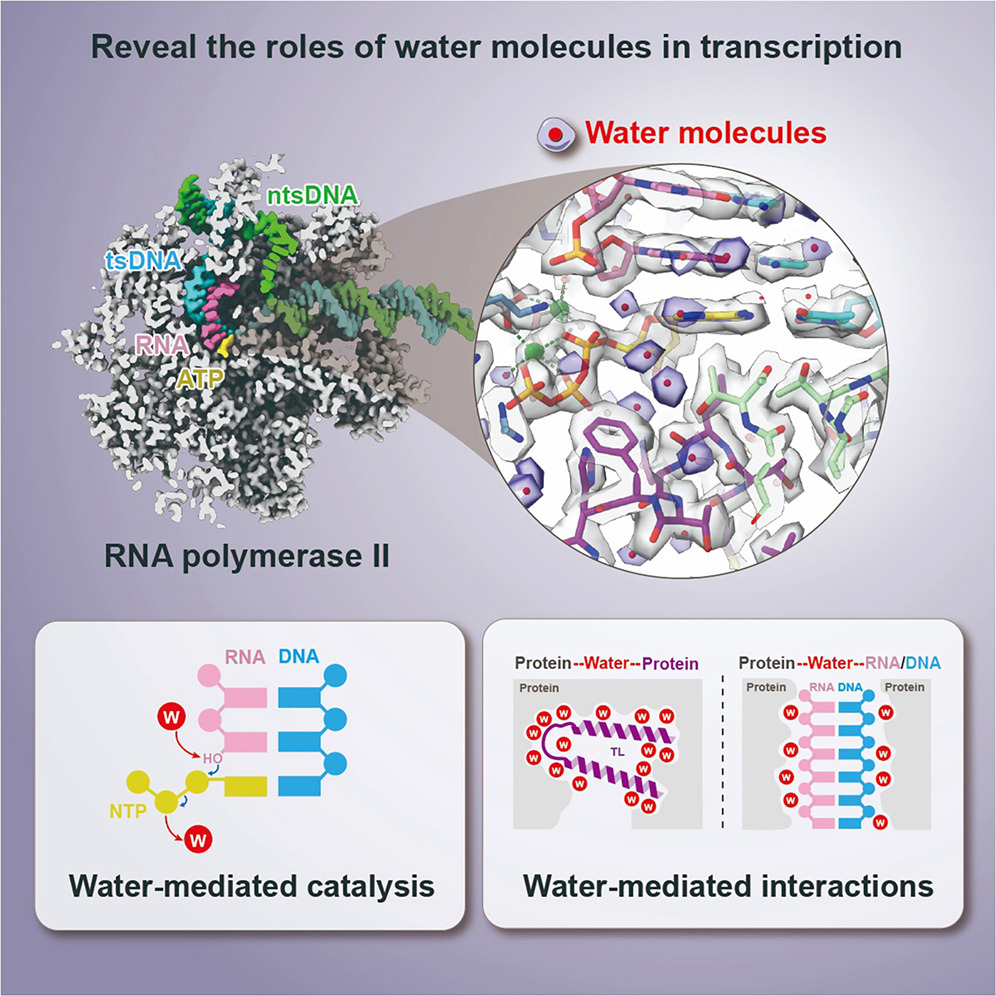
Figure 2. Sub-2 Å cryo-EM structures of RNA polymerase II reveal water-mediated catalysis and molecular interactions.
A key breakthrough is the discovery that water molecules mediate substrate recognition by forming hydrogen-bonding networks that connect RNA substrates with multiple regions of the enzyme. In addition, they play a direct role in catalysis by facilitating proton transfer during the formation of phosphodiester bonds—an essential step in RNA synthesis. These findings resolve long-standing questions about the chemical mechanism underlying transcription. The study also reveals that water molecules regulate the dynamic behaviour of the “trigger loop,” a critical structural element that controls enzymatic activity. By forming and rearranging transient interaction networks, water molecules help stabilise conformational changes required for efficient catalysis. Beyond the active site, water molecules were found to shape protein–protein and protein–nucleic acid interactions, forming a hydration layer that may act as a molecular lubricant, enabling RNA polymerase II to move smoothly along DNA during transcription.
Together, these findings challenge the traditional protein-centric view of transcription and establish water as an essential structural and functional component of the transcription machinery. The work represents a major advance in understanding the fundamental mechanisms of gene expression and opens new avenues for studying dynamic molecular processes in biological systems.
The study’s co-first authors are Dr Qingrong Li and Dr Gangshun Yi, with additional contributions from collaborators across the participating institutions. Additional authors are Yue Wu, Sophy Xu, Jenny Chong, and Xuhui Huang.
The work was supported by access to technology at the Oxford Particle Imaging Centre (OPIC), part of the Division of Structural Biology (Strubi). OPIC houses state-of-the art equipment for cryogenic electron microscopy (cryo-EM/cryo-TEM), including Titan Krios and a Glacios instruments, both fitted with direct electron detectors, with access to auxiliary equipment for sample preparation. The primary dataset (1.96 Å RNA polymerase structure) was acquired at OPIC on a Titan Krios with a Falcon 4 detector. Post-publication re-processing of the EER images in super-resolution mode enhanced the final structure to 1.88 Å.